Journal
I Spent $2,300 Trying to Look Less Tired Before an Aesthetician Told Me the Truth (Do This Mirror Test Right Now)
Why "I sleep eight hours and people still ask if I'm okay" — and the reason every eye cream you've bought was doomed before you opened the jar

Go stand in your bathroom right now. Overhead light on. Look at your face.
I'm serious. Go. I'll wait.
Look at the area under your eyes. Look at the flat stretch under your cheekbones. That worn, hollowed-out look — the one that makes people ask if you're feeling okay.
Now walk to a window. Any window with daylight. Look again.
Same face. Ninety seconds apart.
And it looks completely different.
Notice what happened. The tiredness didn't fade because your skin changed. Your skin is identical. It changed because the light hit it from a different angle.
Sit with that for a second.
If the problem were your skin — the texture, the tone, the pigment, the thing you've been buying products for — it would look the same in both rooms. It doesn't. It moves with the light.
Which means the thing everyone is reading as tired on your face is not on your skin at all.
It's a shadow.
And a shadow is not a colour. A shadow is cast by a shape.
Now let me tell you why that one sentence explains everything — why the $90 eye cream did nothing, why the concealer made it worse by 10:30, why you went to bed at nine-thirty for a month and woke up looking exactly the same.
You weren't doing it wrong.
You were treating a colour problem that was never a colour problem.
Every product in that drawer is designed to change the surface of your skin. Brighten it. Hydrate it. Cover it. Add pigment on top of pigment.
Not one of them changes the shape underneath.
And the shape is the entire thing. The shape is what catches the light. The shape is what puts a grey half-moon under your eye at 8am when you slept eight hours.
You cannot conceal a shadow that's being cast by a shape. You can put beige over it all day long. The shape stays. It keeps catching the light. It keeps telling every person in the room that you look wrecked.
That's not a skincare failure. That's an aiming failure.
And once somebody explains where you're actually supposed to be aiming, the whole thing stops being a mystery.
→ See what I'm using insteadI Spent $2,300 Proving It

My name is Diane. I'm 47. I spent about $2,300 over four years on products that were never going to work.
The $90 jar from the department store counter, the one the woman said everyone her age swears by. Eleven weeks, religiously. Nothing.
The little brown bottle everyone's mother has. $76.
Hydrogel patches, $34 a box, three boxes. A jade roller that has lived in my refrigerator for two years and has never made a measurable difference to anything.
A caffeine serum. An LED mask I used four times. A $340 facial that cost more than my week's groceries and left me glowing for about eleven hours.
And a concealer — the good one, the expensive one — that creased into a hard line under my eye by 10:30 every morning, so now it was a tired eye with a beige crack running through it.
Meanwhile I was sleeping seven, eight hours. I drink the water. I've never smoked.
And three or four times a month somebody would tilt their head at me and go, "Are you feeling okay?"
Or my personal favourite, from a woman at work, in front of four other people: "Long night?"
You can't argue with it. What are you supposed to say — no, actually, I slept great, this is just my face now?
After four years of that you stop thinking this product didn't work. You start thinking there's something wrong with me specifically.
So I did what everybody does at that point.
I booked a filler consultation.
What She Told Me Instead

Her name was Nadia. Medical aesthetician, fourteen years in.
I sat down and pointed at my under-eyes and said fix this.
She didn't book me. She turned the mirror around and asked me to tilt my chin up, then down, then up again.
Then she said:
You don't have a pigment problem. You have a volume problem. And you've been buying pigment products for it for years, haven't you.
Four years. About $2,300.
She said something I've thought about most weeks since:
Nobody in my industry is going to tell you this for free, because there's nothing topical to sell you for it. The skincare aisle has no product for a shape. So they sell you the closest adjacent thing — brightening, concealing, hydrating the surface — and you assume it failed because you picked wrong. You didn't pick wrong. There was nothing correct on the shelf.
I asked her the obvious question. Why hasn't my dermatologist ever mentioned any of this?
She shrugged.
"Because the moment a doctor identifies it as volume, the only tool they have is a needle. So either they refer you out, or they don't bring it up. Nobody has an incentive to explain the mechanism to a woman who isn't ready to be injected."
She was going to make about $800 off me that afternoon.
She talked me out of it.
→ This is what she recommended insteadThe Part Nobody Explains

She explained it to me like I was five. Honestly? That's what I needed.
"Under your cheeks and around your eye sockets there are pads of fat," she said. "They're what gives a younger face that slightly cushioned look. Starting in your late thirties, they lose volume."
"They don't sag. Everyone says sag. They deflate."
"When they deflate, the bone underneath sits closer to the surface. And you get a small hollow."
"A hollow catches shadow. Shadow reads as tired. That's the whole chain."
Then she said the thing that actually stopped me:
It's topography. Not pigment. Every product you've bought was formulated for pigment.
I asked why the collagen creams hadn't done anything, since half of what I'd bought said collagen on the front.
She almost laughed.
"A collagen molecule is enormous. Roughly three hundred thousand daltons. Your skin barrier lets through molecules under about five hundred."
I asked her to say that in normal words.
It's six hundred times too big to get in. It sits on top, it makes your skin feel nice for an hour, and then you wash it off. It's a word on a label.
Six hundred times too big.
I'd been buying that for four years.
"So what's small enough?"
That's when she brought up PDRN — polynucleotides, out of Korean skincare. Not collagen. A completely different category of ingredient, one that conditions the skin and holds water in the tissue itself, so the area sits fuller instead of flatter.
And if the problem is a hollow catching shadow, that is the only category of thing that was ever going to matter.
You don't cover the hollow.
You put something in it.
Then she pointed out the part I hadn't considered — the same deflation is happening along your jawline and in your lips at the same time. It's one process, three places. Which is why women my age end up buying three separate products and getting nowhere with all three.
Go Look In Your Own Drawer

Do this one too. It takes ten seconds.
Go get your concealer. Look at what it actually is.
It's pigment. Beige, in a tube. Its entire job is to lay colour over the top of something.
Now go get your eye cream and read the front of it. Brightening. Depuffing. Firming. Collagen.
Every single one of those words describes something happening on the surface of your skin.
Not one of them describes the shape underneath it.
That aisle is not lying to you exactly. It's just built to solve a problem you don't have — and it will happily take $90 at a time, forever, while the actual thing goes on deflating quietly underneath.
They don't need you to fail. They just need you to keep believing the problem is your skin.
So you buy the next one. And the next one.
And you blame yourself.
And you tell yourself you must be doing it wrong.
You just stopped doing that.
What She Actually Put In My Hand

Before I left, I asked her straight out. If you were me, what would you buy?
She wrote down one thing.
A PDRN balm stick from a brand called Crestora. Ten grams, twist-up, $23.95.
I want to be honest — when it arrived I thought I'd wasted my money. It's pink. It looks like something a fifteen-year-old would put on her lips. I rolled my eyes at it.
4.8 out of 5 across more than 10,000 verified customers. 94% said their skin looked plumper after two weeks. Thirty days to send it back for a full refund.
I ordered it in the parking lot outside her office.
→ Check if it's still in stockThree Weeks, Day By Day

Day 1: I felt ridiculous
Twist, glide, press. Under-eyes, cheeks, jawline. Ten seconds, maybe twelve because I was reading the instructions.
It melted in faster than I expected and didn't leave anything greasy behind. My skin looked cushioned within a couple of minutes — but I'd had that from a hundred products before, so I filed it under nice, means nothing.
I fully expected to be writing this off in a fortnight.
Day 4: The half-moon got shallower
I was putting on mascara and I stopped.
The dark half-moon under my right eye — the one I've been covering and re-covering since I was 43 — wasn't gone. It was shallower. Less like a dent.
I assumed I'd slept unusually well. I checked my sleep tracker like an idiot. Six hours and fifty minutes. Worse than average.
That was the first time I thought: oh. She was right about the shadow.
Day 10: My husband noticed the wrong thing
Nineteen years of marriage. He has commented on my skincare exactly zero times in all of them.
Day ten he looked at me over breakfast and asked if I'd done something different with my hair.
I hadn't touched my hair.
That's the tell, by the way. When people can see a change but can't locate it, that's the good version. That's the opposite of walking into a room having had work done, where everybody can locate it immediately and nobody says anything.
Day 14: The break room
The woman at work. The long night one.
She looked at me across the break room and said, "You look really well lately."
I said thanks and went and sat in a bathroom stall for a minute.
I'm not proud of that. But four years of being asked if I'm okay, and then that.
Day 21: I stopped reaching for the concealer
This is the part I didn't see coming.
I didn't decide to stop using concealer. I just picked it up one morning, looked at my face, and put it back down, because there wasn't a thing there that needed covering.
I've since noticed the jawline thing too — that soft, slightly undefined edge I'd been trying to fix with contour powder for two years. Cushioned skin catches light differently. It reads more defined without me doing anything to it.
Three weeks. A pink stick I laughed at.
I'm Not The Only One
I went and read the reviews properly afterwards, which is backwards, I know.
Read the third one again. That's the whole reason I've actually stuck with it.
That's the honest bar. Not whether something works in a lab. Whether it's easy enough that you're still doing it on day twenty-one, when the novelty has worn off and you're late.
→ See the rest of the reviewsOne Honest Warning

I have to be straight with you about availability, because I nearly got caught out myself.
Crestora is not a big brand. They make one product. PDRN is a Korean-sourced ingredient and it doesn't get manufactured on demand — batches are produced on a fixed schedule and shipped in, and when a run goes, it's gone until the next one lands.
They've already sold out once this year. Their own site is currently flagging that this restock is moving faster than expected.
What happens if you wait:
Checking takes thirty seconds. If it's showing in stock, I'd get it now.
If it says Sold Out — you waited too long.
→ Check current stockTwo Paths
Path 1: You close this tab.
Nothing changes.
Tomorrow morning you stand under that overhead light and see the same hollow, and you cover it with the same beige, and it creases by 10:30 the same way it always does.
Next week someone tilts their head at you and asks if you're feeling okay, and you say yes, and it lands the same way it always does.
Next month you buy the next eye cream. The $90 one with the new molecule on the front. You give it eleven weeks, like you always do.
A year from now? Same drawer. Same shadow. Same question at the break room table. And the hollow will be very slightly deeper, because that part doesn't stop.
Path 2: You check if it's in stock.
Thirty seconds.
Tonight you twist it up and press it into your cheeks, jawline and under-eyes. Ten seconds.
By the end of the first fortnight you notice the half-moon is shallower — 94% of women did, in two weeks.
Somebody at work tells you you look well, and can't say why.
A year from now, that question just isn't part of your life anymore. And if it doesn't work, you send it back inside thirty days and you're out nothing.
The choice is genuinely yours.
→ See if it's still in stock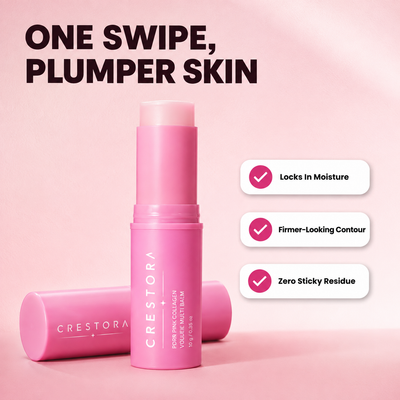
Crestora Pink PDRN Collagen Plump Stick
Results vary between individuals. This content is for general information only and is not medical advice or a substitute for it. Patch test before first use. If you have or suspect a specific skin condition, consult a qualified healthcare provider.